On 29 September 2026, Latura, Primus Vision and BlackFrost held AI in Security: Practical Tools and Solutions You Can Start Using Today online on Microsoft Teams. The webinar was aimed at security-sector business leaders and decision makers exploring how AI could fit into their organisations’ day-to-day work.
The morning began with Latura’s diagnostic findings and physical security playbook. Presentations from BlackFrost, Primus Vision and Elitez then covered software development, workforce learning and the experience of adopting AI within a business. Hariz from the Skills and Workforce Development Agency (SWDA) then covered the Workforce Development Grant and the Career Conversion Programme for Security Officers. A preview of Temasek Polytechnic’s planned training programmes followed, before the panel discussion.
Opening presentation · Latura
Kayne Lim: assessing the starting point and planning a trial
Kayne opened with an early snapshot from Latura’s security diagnostic: 14 completed submissions from respondents who identified themselves as C-suite or senior management. The mean score was 11.6 out of 16 (72.3%), and the median was 11.5 out of 16. Answers to general AI fundamentals were correct 94% of the time, compared with 56% for advanced general questions and 70% for security scenarios.
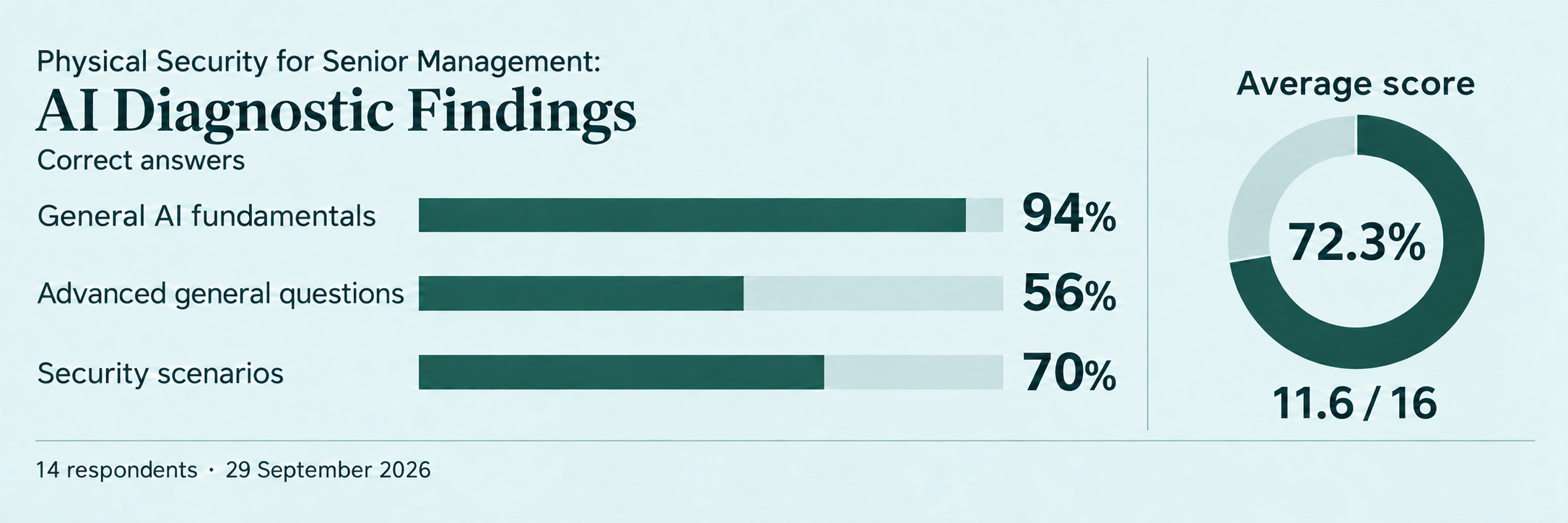
He used the difference to discuss the judgment involved in applying AI at work. Questions about checking a report under time pressure and including recurring technology costs in a comparison proved harder for the group. As Kayne noted during the session, the sample was small and did not represent the whole industry; it gave Latura a starting point for identifying learning needs.
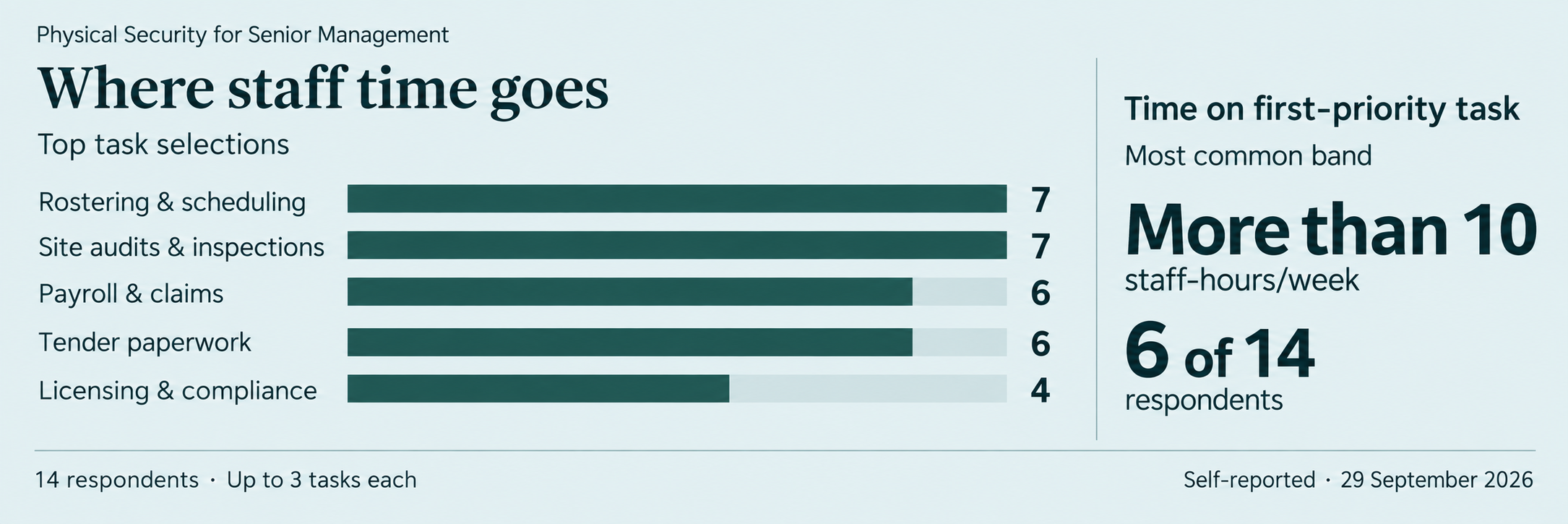
The diagnostic also asked which tasks consumed the most staff time. Rostering and site audits each received seven selections, while payroll and tender paperwork each received six. Licensing and compliance received four. Participants could choose up to three tasks.
For the task each respondent made their first priority, more than ten staff-hours a week was the most common time band, reported by six of the fourteen respondents. This counted the weekly effort across all staff involved. All three respondents who prioritised rostering reported more than ten hours. These figures were participants’ own estimates of workload.
From the findings to the playbook
Kayne then introduced Latura and Security Xchange’s physical security AI playbook, explaining how its sector examples, adaptable prompts and Grab-and-Go Pack could support a first trial. An illustrative rostering workflow showed job requirements, availability and qualifications feeding into proposed assignments. Gaps and conflicts remained visible for a supervisor to resolve before approval. Kayne described this as a concept to test against an agency’s actual operating rules.
His discussion of prompting emphasised the information behind a useful result: the task, relevant records, operational requirements and a clear idea of what good work looked like. The playbook’s prompts were starting points to adapt. He cautioned against treating a fixed prompt formula as the skill in itself.
The incident-report example made the distinction more concrete. A delay could begin with missing facts, difficulty writing, inconsistent formats or a queue awaiting approval. Kayne walked through Latura’s preset workflow guide to show how those causes could lead to different interventions. In the example where the facts were complete but drafting took too long, AI-assisted writing was one option, subject to an approved tool, suitable data and human review.
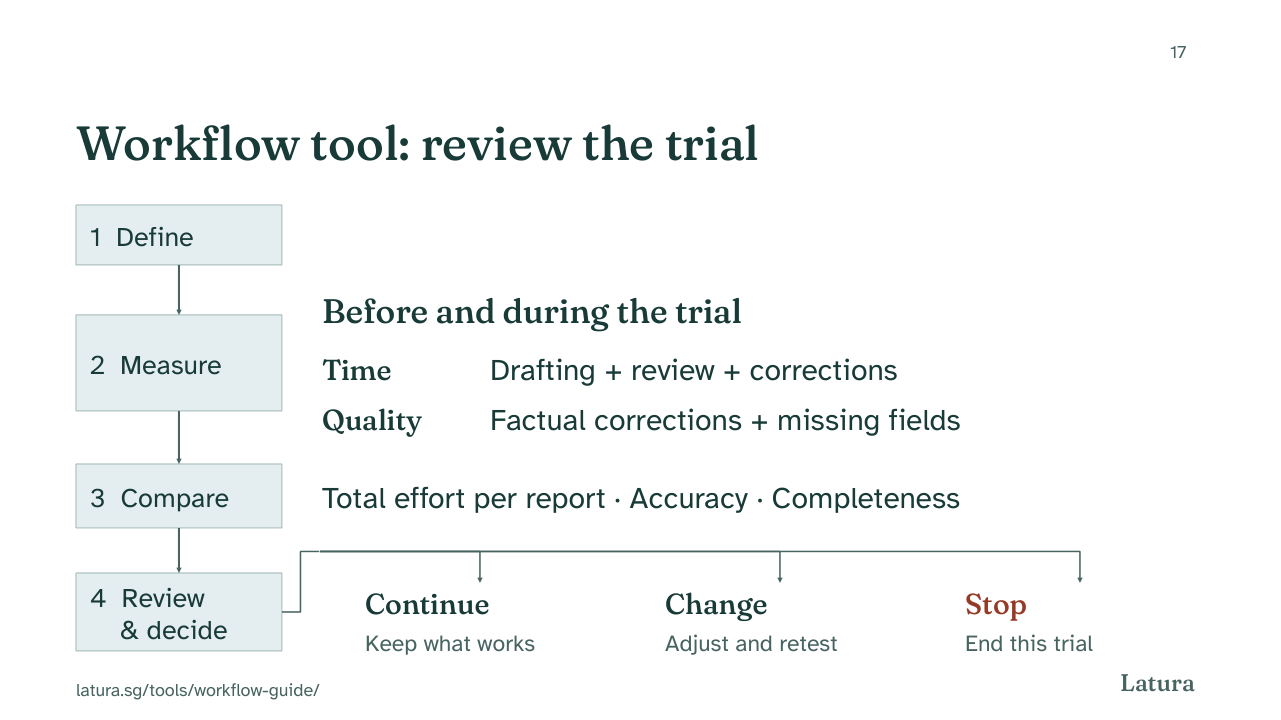
The trial framework counted drafting, review and correction time together, alongside factual corrections and missing required fields. Comparable work would be measured before and during the trial, with waiting time recorded separately. The team would then decide whether to continue, change the approach or stop.
Kayne closed by inviting participants to use the playbook, discuss their team’s learning needs with Latura and join its AI community. He also invited providers to contribute relevant expertise and resources as Latura developed the playbook’s directory.
Software and operations · BlackFrost
Keith Tan: connecting tools to the job
Keith followed with a scenario familiar to security operations: an officer had not arrived for a morning shift, leaving the operations team to find a replacement while checking availability, hours and qualifications. He used it to explain the work involved after an attendance system flagged a problem.
Keith showed examples from other industries, including extracting product information from a photograph, bringing urgent tasks into one view and following up on attendance. He discussed how similar approaches could support security operations, while distinguishing those existing examples from the security-specific system his team was developing.
That proposed system connected check-ins with replacement searches and downstream records. Keith described a smaller initial scope in which AI could draft an incident report or suggest a replacement officer, with a person checking the result. He also explained that client feedback had shaped successive versions of the tools he showed. His proposed measure of value began with the existing job: who performed it, how often and how long it took.
Workforce learning · Primus Vision
Ezril Jamil: training for the work people need to do
Ezril of Primus Vision turned to the capabilities employees would need to put those tools to use. His presentation questioned the value of sending everyone on the same course when leaders, managers and frontline teams had different responsibilities.
He described a progression from understanding AI’s limitations and risks to practical applications, workflow design and implementation. Leaders needed to give direction; managers needed to understand how work would change; employees needed relevant practice. More advanced work on automation and integration required its own learning path.
A demonstration video showed a worker reporting a problem with solar panels through a wearable device. Spoken observations were developed into a structured report, with follow-up information and photographs added along the way. Ezril used the example to connect training with an actual sequence of work, and stressed human responsibility for the output.
An organisation’s experience · Elitez
Derrick Teo: leadership involvement and the gains from adoption
Derrick, Elitez’s co-founder and CEO, shared his organisation’s experience of adopting AI. He described how becoming involved in learning and building himself had changed the pace of implementation, and how an internal AI club gave colleagues a way to develop workflows of their own.
Among the examples he showed was a process that extracted information from incoming timesheets for use in spreadsheets or payroll. His presentation also covered the effort required to bring other leaders along: learning the tools was part of the work, but so was agreeing how they would be used across the company.
Derrick devoted a substantial part of his talk to what happened after productivity improved. He discussed how a company and its employees might share the gains through changing responsibilities, rewards and business performance. He presented this as an ongoing management challenge drawn from Elitez’s experience.
Workforce funding · SWDA
Hariz Azhar: support for job redesign and reskilling
After Derrick’s presentation, Hariz outlined two sources of funding support for companies changing their operations and workforce roles.
Workforce Development Grant
Hariz introduced the Enterprise Workforce Transformation Package (EWTP) and explained the Workforce Development Grant (WDG) within it. His overview covered support for workforce consultancy, capability building and workforce technology solutions. He connected these areas to AI adoption through the work of redesigning jobs and processes, identifying new skills and preparing employees for changed responsibilities.
Career Conversion Programme for Security Officers
He then covered the Career Conversion Programme (CCP) for Security Officers, describing how it supported the reskilling of existing officers for new or additional job functions. Examples included facilities management, emergency response and operating technology. He also explained that eligible employers could receive salary support during the programme.
Hariz’s segment linked the funding discussion to the changes taking place behind a technology deployment: how jobs would evolve and what employees would need to learn to perform them.
Training programmes · Temasek Polytechnic
Norlisa Othman: a preview of security-sector AI training
Norlisa of Temasek Polytechnic’s Security Industry Institute followed with a preview of three programmes planned for the end of 2026. These covered practical AI for frontline operations, open-source intelligence and AI for security professionals, and more advanced intelligence analysis and monitoring. The progression ran from everyday communication and reporting to more specialised intelligence work. Participants were invited to register interest while the programmes were being prepared.
Panel discussion and audience questions
The discussion returned to implementation
Kayne, Keith, Ezril and Derrick returned for a panel on skills, starting points and operational value. The first question concerned the skills employees would need to work alongside AI. Responses focused on understanding a task well enough to break it into steps and explaining a problem clearly. Derrick illustrated how an apparently simple problem with late arrivals could involve advance planning and shift communication.
When the discussion moved to where a security company should begin, the speakers returned to assessing current capabilities and practising on real work. Keith reiterated the need for a before-and-after comparison; Ezril discussed learning at a suitable level and giving participants hands-on practice.
Audience questions brought the conversation to daily deployment, site operations and QR-based attendance records. The responses included discussion of developing and demonstrating suitable tools, alongside the value of small prototypes for understanding requirements. The panel ended by considering how sustained AI adoption might affect companies’ capabilities, competitiveness and ability to attract staff.
Across the morning
What connected the presentations
The clearest connection was the work of defining a problem before choosing how to use AI. Kayne’s incident-report example showed why the initial complaint—reports taking too long—was not enough to specify a useful intervention. Missing facts could call for a capture checklist; inconsistent formats could call for a shared template. AI-assisted drafting became an option when the facts were available and writing was where time was being spent.
Derrick returned to that distinction in the panel. An officer’s late arrival described what had happened, but did not explain whether shift notice or advance planning had contributed. His example extended the discussion from describing a task to understanding its cause. Together, the two examples showed why choosing a tool too early could leave the original difficulty unresolved.
Ezril connected problem definition to the choice of training. His starting question was what business problem an organisation was trying to solve; the workflow and tools would then help determine what employees needed to learn. This put training within the same decision about how work would change. The closing remarks returned to organisations’ own operational needs as a starting point for adoption, with providers, training partners and workforce support available to help.